Emily Dickinson
Insight into a Poetic Genius!
Bio
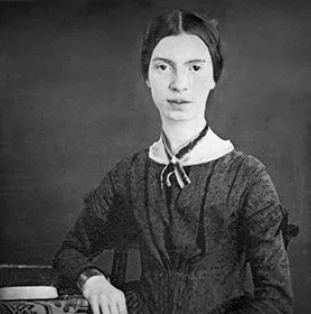
Emily Elizabeth Dickinson was born on December 10, 1830 in Amherst, Massachusetts. She was one of three children born to Edward Dickinson and Emily Norcross. Emily was an intelligent young lady who excelled at story writing even at a young age. As she grew, she found the symbiotic relation between the verse styles that arise through poetry and the musical flow one finds through being a well-versed musician, having practiced and excelling in various creative art styles. This poetic-musical flow continued as she continued growing in poetry, such that this aspect of her style gained notice amongst those who critiqued and reviewed her work, pre and post-mortem. One author, devoting a work to Dickinson, mentions that “to her, literature was improvisation, much like her concoctions at the piano, remembered by all who heard them…” (WINEAPPLE, BRENDA. “On Emily Dickinson.” Salmagundi, no. 170/171, 2011, pp. 132. JSTOR, http://www.jstor.org/stable/41638726. Accessed 12 Feb. 2020.) She attended college at Mount Holyoke Female Seminary until her father abruptly pulled her from school, supposedly due to her ongoing health issues. Once she returned home she spent most of her time doing household chores, duties and entertained the normal female role of that time. It wasn’t long after she returned home that she found herself becoming more and more secluded from the outside world. She did have a few friends/acquaintances but most of these people she kept in contact with through letters only. One person, in particular, that she corresponded with frequently was her friend/sister-in-law, Susan Gilbert. It is believed Emily would often share her poetic ideas with Susan. Due to her secluded lifestyle, Emily never did marry. Although, there have been questions/rumors regarding a romance blossoming between herself and Judge Otis Phillips Lord prior to his death.
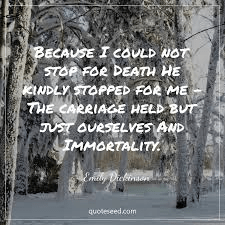
During her years at home, Emily spent much of her time writing poetry. Few of her poems were published prior to her death. These poems were said to be published anonymously or maybe even without her knowledge. Emily Dickinson died on May 15, 1886 at the age of 55 from a kidney disease. After her untimely death, her sister, Lavinia, discovered approximately 1700 poems written by Emily. Many of her poems were published after her death. Emily would never know to what extent the effects of her poems would have on so many people. One theme that can be pulled from some of her poems is the sense of an almost religious devotion. It can be suggested that this influence came from her previous years in Seminary, as well as, from other poets that influenced her. One poem in particular that touches on this metaphysical sense is “Because I could not stop for Death,” where after she and Death leisurely experienced life and memories, they turned together towards “eternity”, which one could easily imply as Heaven.
Literary Merit
In today’s world, Emily Dickinson is considered a poetic genius. However, due to her quiet and secluded lifestyle, very few people got to enjoy her vast creativity prior to her death. She received no awards or notoriety during her lifetime but continued to write the poems that so eloquently flowed from her thoughts to the pen to the paper. Not until after her death did she become recognized for her exemplary and articulate writing style. Not being familiar with the mass amount of poems she did write, I found the ones I read seem to show her ability to utilize religious aspects, as well as, the quest to project her desire for love and romance. “Many of her poems refer to an invisible lover, – an object of devotion” (Pettinger). In the poem, “Because I could not stop for Death,” Emily Dickinson brings forth her profound sense of solace with the innate ideology of the journey towards death. this is observed throughout the poem but seems to be most noteworthy in the second stanza when she writes, “And I had put away my labor and my leisure too” (Dickinson). While breaking down the meaning of each stanza, I found myself enamored by her sense of calmness, ease and acceptance of death itself. I wondered, at this point in my life, if I would be able to find the tranquility she so seemingly embraces in her writing.
Works Citied:
Dickinson, Emily, “Because I could not stop for Death,” Poets.org, https://poets.org/poem/because-i-could-not-stop-death-479 (accessed February 6, 2020).
Pettinger, Tejvan. “Biography of Emily Dickinson“, Oxford, UK. www.biographyonline.net 26 June 2006. Last updated 18 Feb 2018.
Poetic Devices
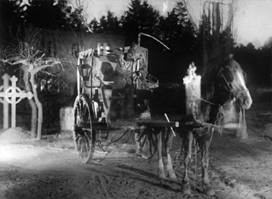
Simile: ” A swelling of the Ground” (Dickinson, Because I could not stop for Death), is a simile used to describe the burial site or grave site. Metaphor: “The Carriage held but just Ourselves” (Dickinson, Because I could not stop for Death). The carriage is a metaphor used here to express the journey she takes while reminiscing about her life. Tone: The tone she projects in the poem is one of peace, calmness and acceptance of her life and her death. Imagery: While reading the poem, Emily Dickinson makes it easy for one to picture her sense of comfort on her slow paced journey in the carriage. As she is passing the school children one can see she is reminiscing of her past. Once she reaches her final resting area we can picture a female standing beside a grave site in a cold and dreary place wearing nothing but a thin gown and scarf.
Works citied:
Dickinson, Emily, “Because I could not stop for Death,” Poets.org, https://poets.org/poem/because-i-could-not-stop-death-479 (accessed February 6, 2020).

Analysis of poem
Journey of Death
The thought of death can be an unnerving and traumatic concept to many. However, as we witness in, “Because I could not stop for Death”, the author, Emily Dickinson, projected a different attitude towards the subject. In the poem, the character begins her journey towards her final resting place with ease, grace and comfort. As her journey continues do her thoughts change? Does she remain steadfast and unwavering as she ventures closer to her final resting place?
As the poem starts it is easy to sense the tone and ease Emily Dickinson has with the idea of death. It’s almost as though she is welcoming this point of view. She uses 6 stanzas in this lyric poem, each containing four lines (quatrain). In each stanza you can feel or sense where she is and what she is experiencing during her journey. In the first stanza, she acknowledges that death is inevitable. It’s as if she embraces the idea of death and her life journey as she climbs into the metaphoric carriage that is navigated by the personification of death himself. In the second stanza, her tone is still that of being relaxed with what is in store for her. We imagine the carriage continuing on its journey at a slow steady pace. There is no work to be done or stress to have. In the third stanza, one can imagine the carriage meandering past the school yard with kids playing while she remembers and reminisces of her own childhood. They then pass the fields that are the metaphor of her adult life. It’s now time to come upon the setting of the sun, the setting of life. In the fourth stanza, she starts to realize the end is approaching. The sun has set and it becomes dark, dreary and cold. She then realizes she is dressed simply in a thin gown and scarf. In the fifth stanza, they come upon her final resting place. A simile is used here when comparing “…a House that seemed/ A Swelling of the Ground” (Dickinson, Because I could not stop for Death), to a grave site. Here she is at her final resting place. In the sixth stanza, she has been died for centuries, but yet her spirit doesn’t feel as though its been that long. She uses the “Horses’ Head” as a metaphor for death for eternity.
In conclusion, Emily Dickinson’s poem, “Because I could not stop for Death,” portrays the awareness that life is not eternal. Life comes to an end for all of us. How we choose to approach the inevitable is up to us. Emily Dickinson chose to embrace the idea of death and to look back on her past and ponder with grace and ease and to accept her fate in her final resting place.
This particular poem by Dickinson has had an everlasting effect that, even after her death, is being used in today’s pop culture–interestingly enough, along with a television series focused on Dickinson’s life. Below I have included a link to one of the main tracks dedicated to the new series, performed by Hailee Steinfield. As you listen, try to observe the parallels between the poem and the lyrics that Steinfield uses: https://www.youtube.com/watch?v=pFp05alGLow
works citied:
Dickinson, Emily, “Because I could not stop for Death,” Poets.org, https://poets.org/poem/because-i-could-not-stop-death-479 (accessed February 6, 2020).
My Favorite Poem
My favorite poem from Emily Dickinson, that I’ve read so far, would have to be “Hope is the thing with feathers.”
Here is an example of multiple poets reciting this work by Dickinson: https://www.youtube.com/watch?v=SitTvcIusz0

Discussion Questions:
Emily Dickinson uses the word “Hope” as a metaphor in this poem. What is she comparing “Hope” to?
Could this poem be considered religious? Why or why not?
 Allison's Poetry Analysis